
History of UL9540
UL 9540 from 2016 to Today:
How a Young Standard Reshaped Energy Storage Safety
INTRODUCTION
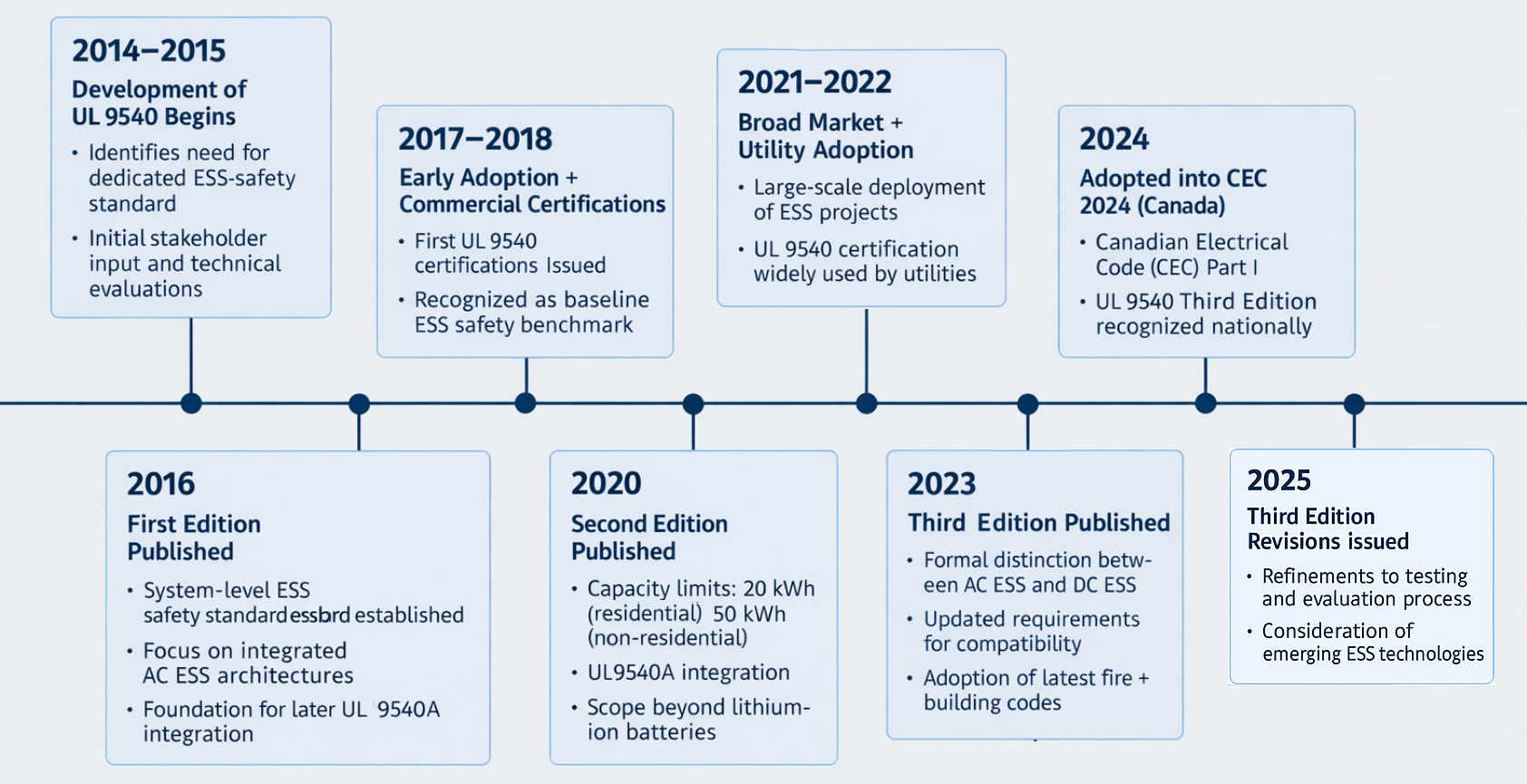
In less than a decade, UL 9540: Standard for Energy Storage Systems and Equipment has gone from a brand-new concept to the de facto standard for commercial and residential battery energy storage in North America. First published in 2016, the standard has gone through three major editions, each one responding to rapid changes in technology, fire-safety knowledge, and installation codes such as NFPA 855.
UL 9540 has changed how manufacturers operate, as well as how Authorities Having Jurisdiction (AHJs), fire officials, and electrical inspectors evaluate projects. UL9540 defines what to look for on drawings, what documentation reviewers should expect in permitting applications, and how comfortable inspectors feel when they approve systems that can store tens, hundreds, or thousands of kilowatt-hours of energy in one place.
This topic traces UL 9540’s evolution from its First Edition (2016), through the Second Edition (2020), and into the Third Edition (2023, with 2025 revisions), highlighting:
- The key regulatory and safety requirements in each edition
- How each version improved on the previous one
- The practical impact on AHJs and inspectors
Development of UL9540
UL9540 was developed in response to emerging safety concerns, the rapid evolution of lithium battery technology, and the need for system-level certification that extended beyond simply testing individual components.
Two major factors drove the development UL9540:
- Emerging lithium-based energy storage
- Increasing numbers of fires and safety incidents
The Rise of Lithium-Based Energy Storage (2010–2014)
In the early 2010s, lithium-ion batteries began moving from consumer electronics into:
- Residential solar + storage systems
- Commercial backup power
- Utility-scale energy storage projects
Before UL 9540 existed, the standards were:
- UL 1973 → stationary battery modules (component-level)
- UL 1741 → inverters and power conversion equipment
- UL 9540A (in development) → fire-propagation test method
However, there was no standard evaluating an ESS as a complete, integrated system, including the battery, BMS, inverter interactions, enclosure, wiring, thermal management, and safety controls. This gap became unacceptable as systems increased in size and energy density.
Early Fires and Safety Incidents
Between 2011 and 2014, several ESS fire events in the U.S. and elsewhere raised urgent safety concerns. Investigators found that the problem was not just the battery cells, but the interaction of the entire system (thermal runaway propagation, enclosure behavior, protection logic, charging controls, and so on) that contributed to the fire.
This insight prompted regulators and standards developers to recognize that component-level certification was insufficient for an ESS.
EARLY UL DEVELOPMENT
UL Begins Developing a System-Level ESS Standard (2014–2015)
Recognizing the need for a unified evaluation method, Underwriters Laboratories initiated the development of a new standard focused on:
- Overall system safety
- Fire and electrical hazards
- Thermal management
- Communication between components
- Installation and operational behavior
During this period, UL worked closely with:
- ESS manufacturers
- Battery chemistry experts
- Fire protection engineers
- NFPA and IFC technical committees
- Utilities and AHJs
Stakeholder meetings, technical workshops, and draft reviews led to the development of the first framework, which ultimately became UL 9540.
Integration with UL 9540A (Fire Propagation Testing)
At the same time, UL began developing UL 9540A, a large-scale fire test designed to measure:
- Thermal runaway onset
- Propagation behavior
- Off-gas production
- Flame and heat release characteristics
Although UL 9540A was published separately, it became an essential input to UL 9540 system certification and later to NFPA 855 and the International Fire Code.
This co-development was a significant aspect of UL 9540’s development.
UL 9540 FIRST EDITION (2016)
In 2016, UL officially released:
- UL 9540 – Standard for Energy Storage Systems and Equipment (First Edition)
The first edition provided:
- A system-level safety framework
- Requirements for integrated AC ESS
- Evaluation of the BMS + battery + PCS as a unified product
- Mechanical, electrical, and environmental tests
- Basic enclosure and thermal safety criteria
This publication marked the first time manufacturers could receive ESS-level certification, not just component listings.
When UL 9540 was first introduced in late 2016, the codes and standards were fragmented.
- Batteries were covered by UL 1973
- Inverters were covered by UL 1741
UL 9540 was the first system-level standard that tied the pieces together. Manufacturers could receive ESS-level certification, not just component listings. The First Edition (ANSI/CAN/UL 9540:2016) defined requirements for energy storage systems intended to receive electric energy and store it for later use, covering both stationary and mobile, and indoor and outdoor systems.
Key elements:
- System-level safety: Safety related to enclosures, controls, interconnections, and thermal management, as well as requirements for integrated AC ESS.
- Electrical performance testing: Verifying ratings, abnormal operation, short-circuit behavior, and protective functions, as well as evaluation of the BMS + battery + PCS as a unified product.
- Mechanical and environmental tests: Vibration, impact, ingress protection, temperature/humidity cycling, and basic enclosure and thermal safety criteria.
- Product markings and instructions: Labels, installation manuals, and warnings.
Most early UL 9540 listings were integrated systems. A battery paired with a specific inverter and controls, evaluated as one self-contained ESS. UL’s first UL 9540 certification was issued to an Enphase home energy storage system in 2016, which illustrates this “fixed pairing” approach.
Relationship with AHJs and Inspectors
For AHJs and inspectors, the UL9540 First Edition simplified their job.
- It provided them with a single system-level listing to search for, eliminating the need to piece together battery, inverter, and BMS compliance manually.
- It aligned with emerging NEC requirements that ESS units be certified to a recognized standard.
Limitations
However, several limitations quickly emerged:
- UL 9540 First Edition predated NFPA 855, so it was not integrated with installation rules being drafted for large battery systems.
- The first edition assumed relatively modest system sizes and simpler, integrated architectures. Grid-scale projects, modular cabinets, and DC-coupled solar-plus-storage systems emerged rapidly and were not fully anticipated.
The UL 9540 First Edition gave AHJs a binary check (“Is it UL 9540-listed?”), but it did not provide the tools required to manage complex ESS sites, spacing, and fire protection. That gap would drive the next revision.
UL 9540 SECOND EDITION (2020)
Aligning NFPA 855 and UL 9540A
UL9540 Second Edition was published on February 27, 2020.
By 2019, several trends had emerged.
- High-profile ESS fires made thermal runaway and fire propagation a top concern.
- NFPA 855, the installation standard for stationary ESS, was finalized in 2020. NFPA included requirements for UL 9540 listing and UL 9540A fire testing.
- Larger, containerized systems and commercial/utility-scale deployments had become common.
The Second Edition explicitly addressed these concerns.
Technical and Safety Enhancements
- Closer integration with UL 9540A
- Large-scale fire testing (UL 9540A) became central to determining spacing, enclosure design, and maximum allowed capacity per unit.
- Manufacturers had to bring UL 9540A data into their UL 9540 reports and installation manuals, making fire-propagation performance part of the listing.
- Metallic enclosures and physical protection
- For many larger systems, metallic enclosures and enhanced construction were required to contain potential fires and protect against mechanical damage.
- Expanded system categories and applications
- More precise requirements for indoor vs. outdoor, residential vs. non-residential, and mobile vs. stationary ESS.
- Additional documentation requirements
- Manuals had to specify maximum system capacity, required spacing, and installation limitations derived from UL 9540A testing and NFPA 855 tables.
The Second Edition turned UL 9540 into a bridge between product certification and installation codes.
Improvements
Differences between the First Edition and the Second Edition:
- Fire-propagation behavior is a core safety attribute, not an afterthought.
- Performance-based data. UL9540A test results and spacing between equipment enhanced decision-making. Separation distances and room layouts were now based on test results rather than guesswork.
- Addressed large containerized systems, which had become common in utility and C&I markets.
Impact on AHJs and Inspectors
For AHJs, the Second Edition brought both clarity and complexity:
- Clarity
Because NFPA 855 explicitly required ESS units to be listed to UL 9540 and tested to UL 9540A, UL 9540 became the accepted “stamp of approval” for system-level safety. - Complexity
Inspectors now had to:- Read and interpret UL9540A test summaries
- Verify installation spacing with the manufacturer’s UL-based tables
- Understand that the UL9540A performance results may result in different spacing requirements for different systems.
Some AHJs quickly adopted checklists to align UL 9540 listings with NFPA 855 placement rules, while others struggled with the learning curve, especially when training and resources were limited.
THIRD EDITION (2023–2025)
AC ESS, DC ESS, and Functional Safety
By the early 2020s, the technology landscape shifted again:
- DC-coupled solar + storage and flexible “DC ESS + separate inverter” architectures exploded in popularity.
- ESS projects grew in scale and complexity, with a variety of chemistries.
- Codes like NFPA 855 and the International Fire Code were updated, further integrating UL 9540A as the preferred fire test method.
The Third Edition of ANSI/CAN/UL 9540, issued on June 28, 2023, was designed to “keep pace with rapidly advancing technology” and better align with installation codes.
New Concepts and Safety Requirements
- Formal distinction between AC ESS and DC ESS
- AC ESS: integrated systems that include the inverter as part of the ESS listing.
- DC ESS: systems that output DC power and are designed to connect to separately listed power-conversion equipment (PCE), such as UL 1741 or UL 62109-1 inverters.
- Both AC and DC ESS are evaluated under the same safety framework, including UL 9540A-based fire testing and system-level protections.
- Alignment with NFPA 855 and fire codes
- Clarified capacity and separation limits based on UL 9540A results to match NFPA 855 and fire codes.
- Include explosion control requirements when applicable.
- External warning and communication systems
- New criteria for early warning and remote notification of potential ESS safety issues, to improve situational awareness for operators and first responders.
- Expanded environmental, noise, and fluid-hazard requirements
- Requirements for noise levels, coolant behavior (including “direct injection” systems), and management of hazardous fluids.
- Functional safety and multi-part systems
- 2025 revisions to the Third Edition add functional safety requirements and clarify markings and documentation for multi-part ESS, along with guidance in Annex H for residential installation instructions.
Third Edition Improvements
There are several improvements to the Third Edition, compared to the Second Edition.
- AC vs. DC ESS clarity
- The Second Edition treated ESS as a single category, heavily biased toward integrated AC systems.
- The Third Edition explicitly recognizes standalone DC ESS as a valid configuration, making it easier to certify modular DC batteries intended to work with multiple inverter platforms.
- Better alignment with modern codes
- NFPA 855 and the 2024 IFC now reference UL 9540A as the preferred fire-test method. The Third Edition clarifies how UL 9540A data determines spacing and capacity limits.
- More comprehensive risk coverage
- New requirements around explosion control, external warning systems, noise, and fluid hazards extend the standard beyond electrical and thermal tests into a holistic view of ESS risk.
The Third Edition transforms UL 9540 from a “one-size fits all” ESS listing into a flexible framework that can handle integrated AC systems, modular DC battery cabinets, and future hybrid architectures, while still imposing a common safety baseline.
AHJs and Inspectors (Third Edition)
The AC/DC distinction and modular DC ESS approach have had mixed impacts on AHJs:
- Benefits
- For integrated AC ESS, the Third Edition continues the familiar model: one UL 9540 listing that covers the battery, inverter, and controls. Inspectors can treat it as a single appliance.
- For DC ESS, the standard explicitly defines compatibility documentation requirements under clauses like 46.14, requiring manufacturers to maintain lists or parameters of compatible PCE. This gives AHJs a formal paper trail to review.
- Challenges
- AHJs must now evaluate two separate listings: 1) DC ESS (UL 9540) and 2) Inverter (UL 1741 / UL 62109-1).
Based on these two listings, the AHJ must verify that the pairing is documented as compatible in the manufacturer’s manuals. - Some inspectors, especially in jurisdictions new to ESS, have struggled with this more nuanced model, initially viewing “UL 9540 DC ESS + UL 1741 inverter” as a loophole rather than an intended evolution.
- AHJs must now evaluate two separate listings: 1) DC ESS (UL 9540) and 2) Inverter (UL 1741 / UL 62109-1).
Even in Canada, where the Third Edition has been incorporated as an ANSI/CAN standard and referenced in the 2024 Canadian Electrical Code, many AHJs are slow to recognize DC ESS listings and modular pairings, continuing to expect fixed AC ESS packages.
SUMMARY
The table below summarizes the three editions.
| First Edition (2016) | Second Edition (2020) | Third Edition (2023/2025) | |
|---|---|---|---|
| Focus | Establish a system-level safety standard for ESS. | Align with NFPA 855 and address lessons from ESS incidents. | Keep pace with advanced architectures and modern codes. Clarify AC vs. DC ESS. Add functional safety. |
| Architecture | Integrated AC ESS; battery + inverter listed as one system. | More robust treatment of larger, modular systems, but still conceptually ESS as a single, integrated category. | Explicit AC ESS vs. DC ESS classification. Support flexible DC ESS paired with separately listed PCE. |
| Safety Features | Basic electrical, mechanical, environmental, and functional safety tests. Limited integration with fire-propagation data. | Tight integration of UL 9540A fire testing, metallic enclosures for many systems, explicit documentation of capacity and spacing limits in manuals. | Clarified capacity/separation rules tied to UL 9540A and NFPA 855, explosion control, external warning systems, noise and fluid-hazard requirements, updated markings and instructions (Annex H). |
| AHJ Impact | Introduced a clear “UL 9540–listed ESS” concept, simplifying approvals for early residential and small C&I systems. | Provided performance-based tools (UL 9540A data and manufacturer spacing tables) but required more technical literacy from inspectors; increased confidence for large ESS at the cost of added complexity. | Consistent treatment of integrated AC ESS and modular DC ESS under a single safety framework. Requires careful review of both battery and inverter listings along with documentation to confirm compatibility. |
CONCLUSION
UL 9540 has evolved in lockstep with the battery energy storage industry.
- The First Edition answered a basic need for system-level safety certification, giving AHJs and installers a common reference point for early residential and C&I ESS.
- The Second Edition integrated fire-propagation testing and NFPA 855 into the standard, shifting the focus from component safety to installation-relevant performance, especially for large, containerized systems.
- The Third Edition, with its explicit AC/DC ESS framework and expanded functional-safety and communication requirements, recognizes that modern ESS may be modular, DC-coupled, and heavily software-driven while still needing a consistent safety baseline across all architectures.
Each edition has raised the profile of AHJs and inspectors.
- First Edition: Is it UL 9540-listed?
- Second Edition: Does the UL 9540A data and spacing comply with NFPA 855?
- Third Edition: Is the ESS UL 9540 (AC or DC)? Is the PCE UL-listed? Does the manufacturer’s documentation identify equipment as compatible? Does the installation match the test parameters?
As of 2025, UL 9540 is deeply embedded in North American regulations, referenced by NFPA 855, the International Fire Code, utility standards, and national electrical codes in both the United States and Canada. As energy storage technology continues to evolve, expect UL 9540 to continue to evolve with it.