
How Solar and Storage Deliver Megawatt EV Charging With Only 200 kW at the PCC
Table of Contents
Project Overview
The Situation
Many EV charging projects begin with ambitious targets, only to be constrained by the utility interconnection. In this case, the developer had access to 200 kW at the point of common coupling (PCC). This was the maximum import capacity supported by the existing infrastructure and was paired with a strict zero-export requirement. No additional service capacity was available, and utility upgrades were not feasible.
Despite these limits, the economic value of deploying high-power DC fast chargers justified moving forward. The challenge became designing an architecture capable of supporting more than 1.4 MW of charging capacity while never exceeding 200 kW of grid import.
Solution Summary
-
System Type: Hybrid Energy Architecture with Battery Energy Storage
-
Grid Connection: 200 kW maximum import with zero-export requirement
-
Charging Capacity: 6 DC fast chargers, up to 240 kW each (1.4+ MW total)
-
Configuration: Multi-MWh AES Cabinet battery storage with integrated solar generation
-
Key Benefits: Megawatt-scale charging on constrained grid, solar self-consumption, predictable interconnection
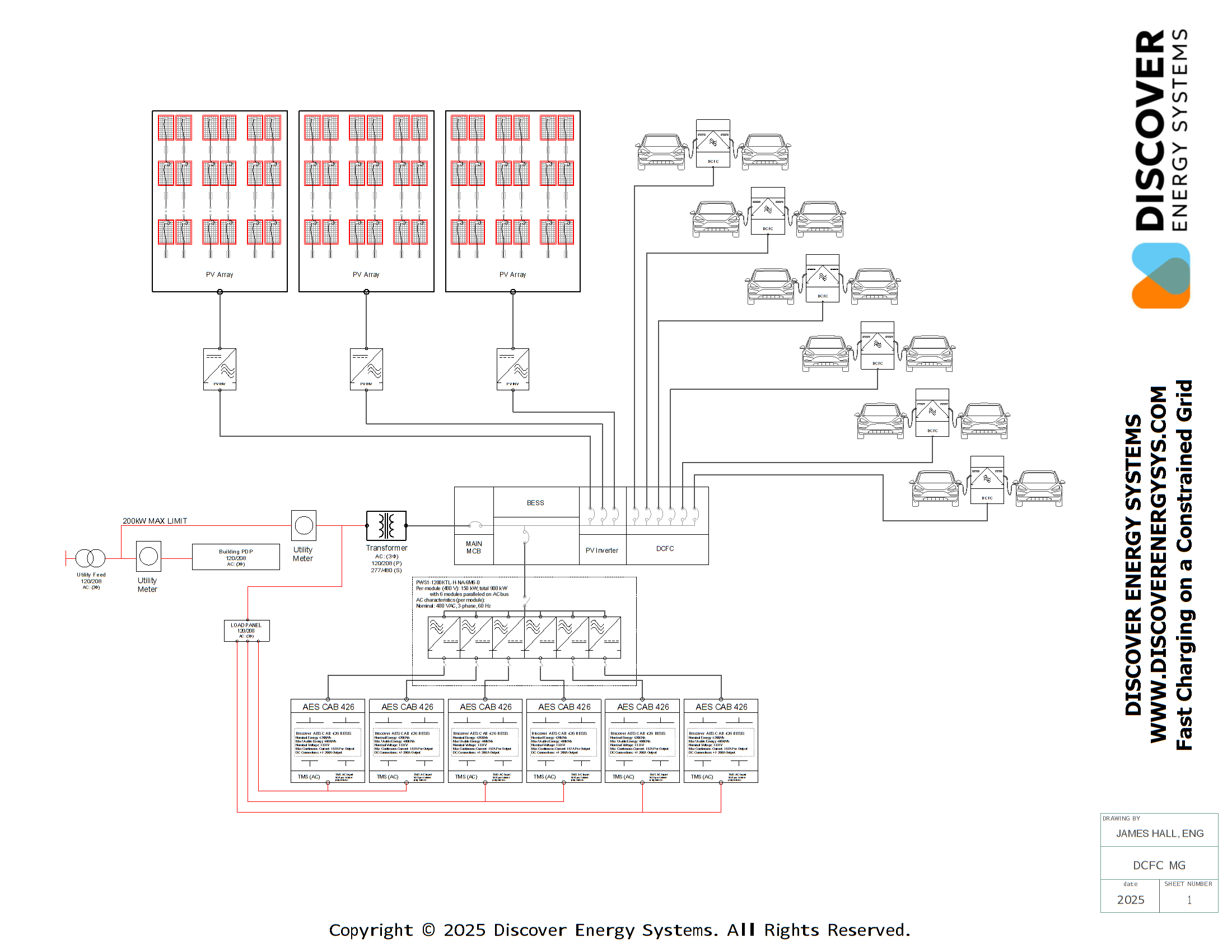
System Diagram (Single-Line Drawing)

The Challenge
Project Requirements
The developer planned to deploy six high-power DC fast chargers, each up to 240 kW. With a combined potential load exceeding 1.4 MW, the math did not work with a traditional grid-connected design. The site needed to:
- Operate within a strict 200 kW import limit
- Maintain zero export at all times
- Support large, fast load swings from EV chargers
- Integrate on-site solar without violating interconnection rules
Industry Context
This combination of requirements is becoming common across commercial and fleet charging projects. Many ideal charging locations have constrained grid service, where large upgrades are expensive, slow, or unavailable altogether.
The Hybrid Energy Architecture
Overview
The solution was to build a hybrid on-site power plant centered around multi-MWh battery energy storage using the AES Cabinet Solutions. These high-voltage outdoor cabinets supply the instantaneous power and energy capacity needed to respond to EV charging demand that far exceeds grid availability.
Energy Storage System
- Battery Platform: AES Cabinet Solutions for multi-MWh capacity
- Power Output: High-voltage outdoor cabinets for instantaneous power delivery
- Response Time: Immediate response to fast load swings from DC fast chargers
- Design Purpose: Bridge gap between available grid capacity and charging demand
Learn about Discover Energy Systems' AES CAB product
Solar Integration
On-site solar generation is fully integrated into the system, but under a strict rule enforced by the Energy Management System (EMS):
All PV output must be consumed on site or curtailed, guaranteeing zero export.
- Primary Use: Offset EV charging demand in real-time
- Secondary Use: Charge battery when headroom is available
- Grid Protection: Never allowed to push power back onto utility grid
- Curtailment Logic: EMS curtails PV when site cannot absorb all generation
System Integration
- Common Bus: All energy sources and loads operate on 480 VAC distribution bus
- Real-Time Coordination: EMS coordinates dispatch across all assets
- Load Management: Dynamic power allocation to DC fast chargers
- Compliance Enforcement: Continuous monitoring of import and export limits
How the System Operates
Operating Boundaries
The EMS governs the site by enforcing three strict operating boundaries:
- Grid import must never exceed 200 kW
- DCFC load must remain within the site's available power resources
- PV generation must never export to the grid under any condition
High-Demand Operation
- Battery Discharge: Supplies additional power to maintain grid import compliance
- DCFC Allocation: Power distributed to chargers within available resources
- Grid Limit Protection: Never exceeds 200 kW import regardless of charging demand
- Load Balancing: Real-time allocation across multiple charging sessions
Low-Demand Operation
- Battery Recharging: Solar generation and grid headroom restore battery capacity
- Solar Utilization: PV output charges battery or directly powers chargers
- Grid Optimization: Uses available import capacity when charging demand is low
- Zero Export Compliance: Excess PV curtailed to prevent grid export
Constrained Resource Management
If available resources become constrained, such as when the battery approaches discharge limits or PV output is low, the EMS dynamically throttles DCFC power to match the sustainable capacity of the site. This prevents overload events and ensures the system always operates within safe and compliant boundaries.
Control Strategy
- Real-Time Monitoring: Continuous tracking of all energy sources and loads
- Predictive Management: Anticipates charging patterns and solar generation
- Dynamic Throttling: Adjusts charger power to match available resources
- Safety Compliance: Maintains stable, predictable site performance
Learn about Discover Energy Systems' C&I controls
This coordinated control strategy enables megawatt-scale fast charging on a 200 kW grid connection while maintaining stable and predictable site performance.
Why Developers Use This Model
Overcoming Grid Constraints
This architecture gives developers a way to deploy high-power EV charging without depending on utility expansion. Many ideal charging locations have constrained grid service, making this solution particularly valuable.
Key Advantages
- Megawatt-class charging with constrained infrastructure - Deploy high-power charging without waiting for utility upgrades
- Solar self-consumption for lower operating costs - Reduce energy costs through on-site generation
- Fast dynamic power support from DES BESS Solutions - Instantaneous response to charging demand
- Predictable interconnection and permitting pathway - Simplified approval process with zero-export compliance
- Scalable from hundreds of kilowatt-hours to multi-MWh installations - Grow capacity as demand increases
Project Risk Reduction
For developers and site owners, this model reduces project risk and accelerates deployment timelines by:
- Eliminating dependency on utility service upgrades
- Providing clear regulatory compliance pathway
- Enabling deployment in high-value locations with grid constraints
- Delivering immediate revenue generation without infrastructure delays
A Replicable Blueprint
The Fundamental Shift
This use case shows that high-power EV charging no longer depends on high-power grid service. With energy storage as the backbone, solar as a cost reducer, and an EMS enforcing both import limits and zero export, developers can deliver the charging capacity they need using the grid capacity they have.
The Architecture in Brief
A simple single-line diagram makes the concept immediately clear:
Solar and grid feed the site, storage fills the power gap, and the grid remains stable and capped.
Universal Application
This is a scalable, repeatable blueprint for any grid-constrained EV charging project, including:
- Commercial DC fast charging stations
- Fleet charging depots
- Highway corridor charging
- Urban charging hubs
- Workplace charging installations
- Multi-family residential charging
Next Steps
Developers and site owners interested in deploying this architecture can leverage proven, standardized components and design patterns to accelerate their projects and deliver megawatt-scale charging in grid-constrained environments.
Contact us to discuss your grid-constrained EV charging project